Part of topic: World War I
The Treaty of Versailles
The Treaty of Versailles, signed on 28 June 1919, officially brought the First World War to an end. Yet instead of a lasting peace it created the conditions that led inevitably to a new and even more terrible conflict. The treaty placed the entire blame for the war on Germany, even though responsibility for the conflict objectively rested with all of its participants.
Military restrictions
The treaty’s terms effectively destroyed Germany as a military power:
- The army was capped at 100,000 men (4,000 officers and 96,000 soldiers), permitted only small arms and light artillery
- The air force was abolished entirely
- Tank forces were prohibited
- The navy was dismantled, the submarine fleet included
- Territory was reduced, and all colonies were transferred to mandates under Great Britain and France
Economic catastrophe
The consequence of the reparations and economic restrictions was the hyperinflation of the 1920s, which entered economics textbooks as a classic example. There is a famous illustration of the scale of the disaster: a man walks into a café and orders a coffee — the price is 3 million Deutschmarks. Fifteen minutes later, when the bill arrives, the price is already 6 billion. Children played in the streets with bundles of worthless banknotes instead of toys.
The situation was so critical that in 1928–1929 the Americans began extending recovery loans to Germany. The logic was pragmatic: it is impossible to collect reparations from a wholly bankrupt country.
The Versailles system and stateless peoples
Versailles in 1919 was not a single treaty but a system of several peace agreements that redrew the map of Europe: besides Versailles proper, these were the Treaty of Saint-Germain (with Austria), the Treaty of Trianon (with Hungary), and the Treaty of Sèvres (with the Ottoman Empire)[6]. Under this system Germany lost all of its overseas colonies, roughly one-seventh of its territory, and a significant share of its population[5]. (By exact figures — around 13% of its European territory and roughly a tenth of its population; the spoken “1/7” and “up to 1/12” are roundings of the same order.)
The flip side of the Entente’s victory was that the new map was drawn unevenly. Many peoples of Eastern Europe received no statehood of their own or found themselves inside foreign states: Slovaks in Czechoslovakia had fewer rights than Czechs; Croats ended up in the Kingdom of Serbs, Croats, and Slovenes (later Yugoslavia); Ukrainians received no statehood at all[6]. It was precisely this injustice that fed interwar revanchism — and not only the German variety.
This context explains why radical nationalist movements among stateless peoples sought not to “correct” but to break the Versailles system. In Dribnytsia’s account, the goal of Stepan Bandera coincided here with that of Hitler: both regarded the system of Versailles treaties as unjust and wished to destroy it rather than revise it at a new conference[7]. A coincidence of tactical aims, however, did not amount to an alliance: why the OUN very quickly found itself in conflict with Nazi Germany — which denied Ukrainians statehood — is examined in a separate analysis, «Was the OUN Fascism?».
Rearmament in circumvention of the treaty
Formally, Germany had no right to full-fledged armed forces. In practice, the circumvention of the restrictions began long before Hitler — and largely on the territory of the USSR. Already in the days of the Weimar Republic, under the Treaty of Rapallo between Soviet Russia and Germany, a secret agreement on military cooperation was in force: ships and submarines were built at the shipyards of Mykolaiv, a school for German pilots operated in Saratov — the technologies were being developed back in the 1920s[1]. The military plants of Soviet Ukraine and Soviet Russia worked for the Weimar Republic, partly supplying its army and weaponry; German pilots, tank crews, and artillerymen trained at Soviet proving grounds[2]. In the literature of the 1990s this phenomenon acquired an apt name: “the fascist sword was forged in the USSR.”
There was, moreover, no single, one-time “withdrawal” of Germany from the Treaty of Versailles: after 1933 it freed itself from the treaty’s restrictions gradually, breaching the conventions step by step[3].
Hitler’s incremental violations
Once in power, from 1935 Hitler began systematically violating the terms of the Treaty of Versailles. The strategy was incremental and calculated on the unwillingness of Great Britain and France to go to war:
- First, Hitler requested permission for a small navy — and obtained it
- Then he expanded the army beyond the set limits
- He introduced universal military conscription
- He remilitarized the Rhineland
Great Britain and France made concessions because the cost of the First World War had been too high for them. At Verdun alone, in 1916, around 600,000 people died on both sides. The societies of these countries were categorically unwilling to face a new great war.
From concessions to aggression
Each year the small concessions to Hitler grew larger. The Allied leaders understood that it was the Treaty of Versailles itself that had brought Hitler and the idea of revanchism to power — and, for the sake of an illusion of security in Europe, they sacrificed Czechoslovakia: all international policy of the 1920s and 1930s was geared toward appeasement rather than war[4]. The policy of appeasement led first to the partition of Czechoslovakia (the Munich Agreement of 1938) and then to the invasion of Poland on 1 September 1939, which marked the beginning of the Second World War.
The Treaty of Versailles showed that a humiliating peace can be more dangerous than war itself. Instead of creating a stable international order, it sowed the seeds of revanchism, which grew into Nazism and a new global catastrophe.
Related persons
- Vitaliy Dribnytsya — Historian, author of the 'Vox Veritatis' channel
References
- [1] paraphrase
Ещё во времена Веймарской республики по Рапалльскому договору между Советской Россией и Германской республикой было тайное соглашение о военной помощи. На верфях Николаева строились корабли и подводные лодки, в Саратове была школа для лётчиков. Военное сотрудничество шло ещё до прихода Гитлера и до выхода из Версаля — технологии нарабатывались ещё в двадцатые годы.
Back to text - [2] summary
На території Радянського Союзу готувалися льотчики, танкісти, артилеристи. Військові заводи радянської України і радянської росії працювали на Веймарську республіку, частково забезпечуючи її армію і зброю. Є книга, яку можна відкрити й почитати з посиланням на документи.
Back to text - [3] paraphrase
Одномоментного выхода из Версальского мира не было — Германия выходила постепенно, начиная после тридцать третьего года, нарушая конвенции.
Back to text - [4] paraphrase
На уступки Германии шли, потому что лидеры понимали, что Версальский договор 1919 года привёл по сути к власти Гитлера, привёл к власти идею реваншизма. И для того, чтобы хоть как-то обеспечить безопасность в Европе, пожертвовали Чехословакией. Идея была — избежать войны: вся международная политика в 20–30-е годы была настроена не на разжигание войны, а на умиротворение.
Back to text - [5] paraphrase
Версальское соглашение наложило ограничение на Германию: Германия потеряла все колонии, 1/7 часть территории, до 1/12 части населения.
Back to text - [6] summary
Очень многие народы в Восточной Европе либо не получили своей государственности, либо оказались в составе других государств: возникла Чехословацкая республика, где чехи имели больше прав, а словаки фактически прав не имели; украинцы не имели своей государственности; хорваты оказались в составе Югославии. Это была система версальских договоров — там же 4 или 5 договоров: трианонский, сен-жерменский, севрский.
Back to text - [7] summary
Система версальских договоров с точки зрения Бандеры, как и с точки зрения Гитлера, должна была быть разрушена, потому что украинцы в результате её не получили государственности — не пересмотреть, собрав заново конференцию, а сломать эту систему договоров как несправедливую.
Back to text
Sources
-
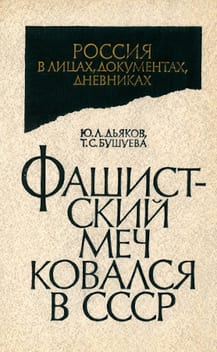 book (1992) Фашистский меч ковался в СССР: Красная Армия и рейхсвер. Тайное сотрудничество. 1922–1933 — Советская Россия A collection of declassified documents on the secret military cooperation between Weimar Germany and the USSR, circumventing the Versailles restrictions; the source of the well-known phrase cited in the video